
SEMO and Me
A Personal History

On July 19, 2010, the Southeast Missourian published a feature story on three SEMO faculty members who had just completed 45 years of service to the university—Richard Francis (math), Dean Monahan (English), and me. It was the first time that three individuals had simultaneously completed that length of service. Richard and Dean retired that year; I went on to teach 48 years and three months, the longest tenure for a faculty member in the history of the school. After that I continued to teach half-time for two more years, and since then have served as a volunteer consultant to the Faulkner Center. So my association with SEMO has now spanned almost 60 years.
My interview by Robyn Gautschy that accompanied that 2010 story is printed below. Reading it again, I still agree with what I said then about work and books. They have both enriched my life.
______________
Mississippi native Dr. Robert Hamblin, professor of English and director of the Center for Faulkner Studies at Southeast Missouri State University, was the first in his family to attend college, let alone earn a doctorate degree. After graduating from Delta State University in Cleveland, Miss., and teaching high school for two years in Baltimore, Hamblin received a fellowship to get his Ph.D. with all expenses paid if he would teach for five years after graduating. With 45 years under his belt at Southeast, it's safe to say that he's met that five-year stipulation.
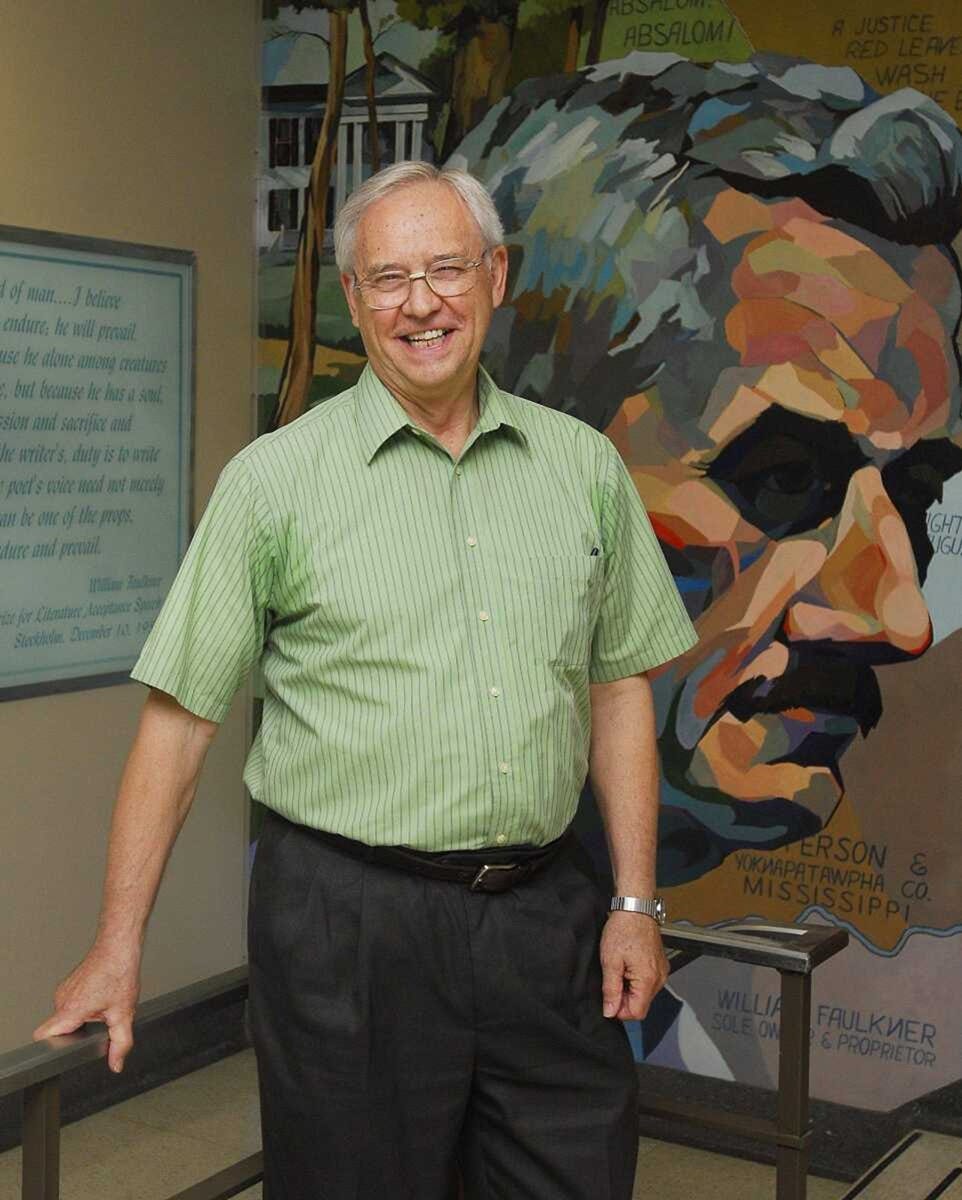
Robert W. Hamblin poses in front of a mural of William Faulkner Wednesday, June 30, 2010. Hamblin is the Director of the Center for Faulkner Studies at Southeast Missouri State University's Kent Library. (Laura Simon)
"This is the one I settled on, or they settled on me," says Hamblin of Southeast. "Those were the days when jobs were aplenty -- schools were growing, enrollment was growing, and they needed faculty with Ph.Ds. It was a good time to enter higher ed."
Hamblin began working at Southeast Missouri State College in 1965. Since then, the school has become a university and entered Division I athletics, student enrollment has doubled, the literary canon has broadened and anthologies have been rewritten.
"Texts have been reshaped and continue to modernize," says Hamblin. "Students are far more tolerant than my generation. ... It's a bigger, broader world. It's not just 'dead white males' anymore."
Hamblin first read William Faulkner at Delta State and studied him more while working toward his Ph.D. at the University of Mississippi, in Faulkner's hometown of Oxford, Miss. Growing up in the South during the civil rights movement, Hamblin says he was far more liberal than most Southerners. He grew up with African-American friends who were not allowed to attend college, and he was one of the National Guard soldiers protecting African-American students when Ole Miss was desegregated.
"It was a frightening time, but it was change that had to come. Faulkner helped me negotiate my own personal walk through these troubled times," says Hamblin, who has since written and co-authored several books about Faulkner. "Reading has helped me personally engage and deal with some of those issues that sometimes my family and neighbors would not help me with. If it were not for books, I would have grown up thinking the whole world was like Mississippi."
But while there has been growth in many ways in 45 years, there have been fallbacks in others. Southeast's staff of 30 full-time tenure-track English professors has shrunk to 20, says Hamblin, and the school now relies heavily on part-time and adjunct faculty.
"There are a lot less opportunities for young people and professors," says Hamblin. "A lot of talented people go elsewhere because they do not have the opportunities I did in higher education." The job market is tougher for Hamblin's students, too -- many of them will find jobs, he says, but it probably won't be their first choice. Through his teaching, Hamblin hopes to encourage students to pursue careers they truly enjoy.
"I hope my students don't spend 40 years looking at the clock," says Hamblin. "I don't believe in TGIF -- if you're looking at the clock, you're in the wrong profession. It's better to take less money and do what you really want to do."
As for Hamblin, he has no plans for retirement.
"I'm still having fun," he says. "The day I decide I'm not having fun, I will retire tomorrow."
Good, too brief summary of a great career; and good advice about career choice. I was still having fun in my second career when I decided to retire; but had postponed other varieties of fun for too long, so quit the job to try the alternatives. That too was a good choice.
And, Bob, you're still going strong and having an influence on many of us.